
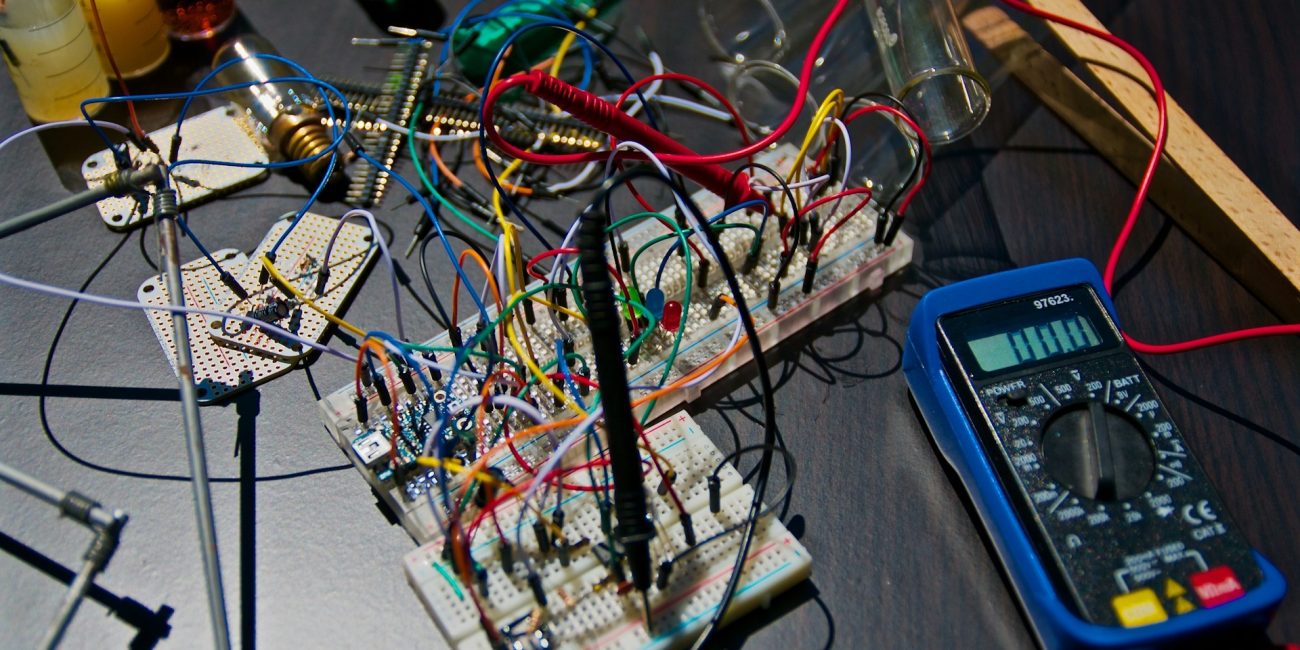
Getting really good at electronics requires a combination of theoretical knowledge, practical experience, and continuous learning. Here’s a detailed roadmap to help you master electronics:
- Build a Strong Foundation
- Learn Basic Physics and Mathematics
- Understand Ohm’s Law, Kirchhoff’s Laws, and basic circuit theory
- Study algebra, trigonometry, and calculus as they relate to circuit analysis
- Study Electronics Fundamentals
- Components: resistors, capacitors, inductors, diodes, transistors, ICs
- Circuit concepts: voltage, current, power, impedance
- Digital vs. analog electronics
- Get Hands-On Experience
- Start with Simple Projects
- Build basic circuits on breadboards or using simulation software
- Practice soldering and assembling circuits
- Use Development Boards
- Arduino, Raspberry Pi, ESP32 for prototyping
- Experiment Regularly
- Modify existing circuits
- Troubleshoot and debug
- Learn to Read Schematics and Datasheets
- Understand symbols and circuit diagrams
- Read datasheets to understand component specifications and pinouts
- Study Electronics Theory in Depth
- Textbooks and Online Courses
- “The Art of Electronics” by Horowitz and Hill
- Online platforms like Coursera, edX, Khan Academy
- Focus on Semiconductor Devices, Amplifiers, Oscillators, Power Supplies
- Practice Circuit Design
- Use EDA (Electronic Design Automation) tools
- KiCad, Eagle, Altium Designer
- Design and simulate circuits before building
- Learn PCB design and fabrication
- Troubleshooting and Debugging
- Develop systematic troubleshooting skills
- Use multimeters, oscilloscopes, signal generators
- Analyze waveforms and signals
- Engage in Projects and Competitions
- Build useful gadgets, robotics, IoT devices
- Participate in hackathons, maker fairs, online challenges
- Join Communities and Forums
- Reddit (r/electronics), EEVblog, All About Circuits
- Ask questions, share projects, learn from others
- Keep Up with Industry Trends
- Follow electronics news, blogs, and YouTube channels
- Explore emerging fields like IoT, embedded systems, AI hardware
- Never Stop Learning
- Take advanced courses in analog/digital design, embedded systems, RF, power electronics
- Read research papers and technical journals
- Experiment with new components and techniques
- Develop Soft Skills
- Problem-solving, critical thinking
- Documentation and communication
- Project management
By consistently applying these steps, practicing regularly, and challenging yourself with complex projects, you’ll steadily become highly proficient in electronics.
Next

December 4, 2025
How is the education system in the USA?
Previous
December 2, 2025
How is the medical system in the UK?





No Comment! Be the first one.