
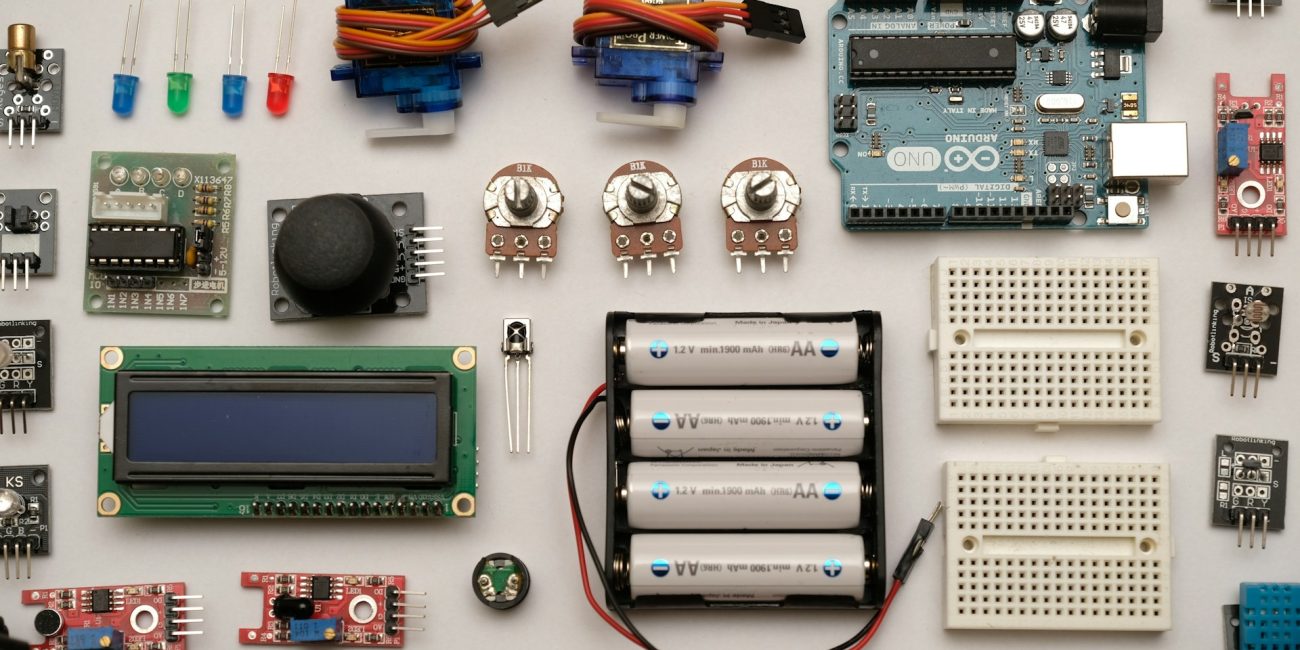
If you’re starting from scratch, the key is to learn both the theory and the hands-on skills at the same time. Electronics becomes much easier to understand when you build simple circuits yourself.
A good learning path is:
- Learn basic electrical concepts
- Voltage (V)
- Current (I)
- Resistance (R)
- Power (P)
- Ohm’s Law (V = I × R)
These concepts are the foundation for everything else.
- Understand common electronic components
Learn what each component does and how to identify it:- Resistors
- Capacitors
- Inductors
- Diodes
- LEDs
- Transistors
- Switches
- Integrated Circuits (ICs)
- Learn to read circuit diagrams
Practice recognizing standard symbols and understanding how components are connected. - Build simple circuits
Start with projects like:- Lighting an LED
- A blinking LED using a timer IC
- A light-sensitive circuit
- A simple buzzer
- A basic amplifier
A breadboard lets you build these circuits without soldering.
- Learn to use basic tools
Become familiar with:- Digital multimeter
- Breadboard
- Power supply or battery pack
- Wire cutters and strippers
- Soldering iron (once you’re comfortable)
- Study digital electronics
After analog basics, move on to:- Binary numbers
- Logic gates
- Flip-flops
- Counters
- Microcontrollers
- Learn a microcontroller
Platforms like Arduino are beginner-friendly and teach both electronics and programming. You’ll learn how sensors, motors, and displays interact with software. - Practice troubleshooting
Most learning comes from fixing circuits that don’t work. Learn to:- Check voltages
- Measure continuity
- Trace signals
- Read datasheets
Recommended beginner books
- Make: Electronics by Charles Platt
- Practical Electronics for Inventors by Paul Scherz and Simon Monk
- The Art of Electronics by Paul Horowitz and Winfield Hill (better after you’ve learned the basics)
Free learning resources
- All About Circuits (excellent tutorials)
- Electronics-Tutorials.ws
- MIT OpenCourseWare (introductory electronics courses)
- Khan Academy (basic electricity)
Suggested first projects
- LED flasher
- Traffic light simulator
- Temperature monitor
- Light sensor
- Electronic dice
- Mini alarm circuit
Safety tips
- Start with low voltages (5–12 V DC).
- Never experiment directly with household mains electricity.
- Disconnect power before modifying a circuit.
- Double-check wiring before turning power on.
A simple 8-week learning plan
- Week 1: Voltage, current, resistance, Ohm’s Law.
- Week 2: Resistors, capacitors, LEDs, and diodes.
- Week 3: Breadboard use and simple LED circuits.
- Week 4: Transistors and basic switching circuits.
- Week 5: Circuit diagrams and multimeter practice.
- Week 6: Logic gates and digital electronics.
- Week 7: Introduction to Arduino or another beginner microcontroller.
- Week 8: Build a small project combining sensors, LEDs, and code.
The most effective way to learn electronics is to combine reading with regular hands-on practice. Even 30–60 minutes of building and experimenting a few times a week will help you progress much faster than studying theory alone.
Other Articles
Next

July 24, 2026
What education do you need to be a nurse in the UK?
Previous
July 22, 2026
What is the most fun educational game?





No Comment! Be the first one.