
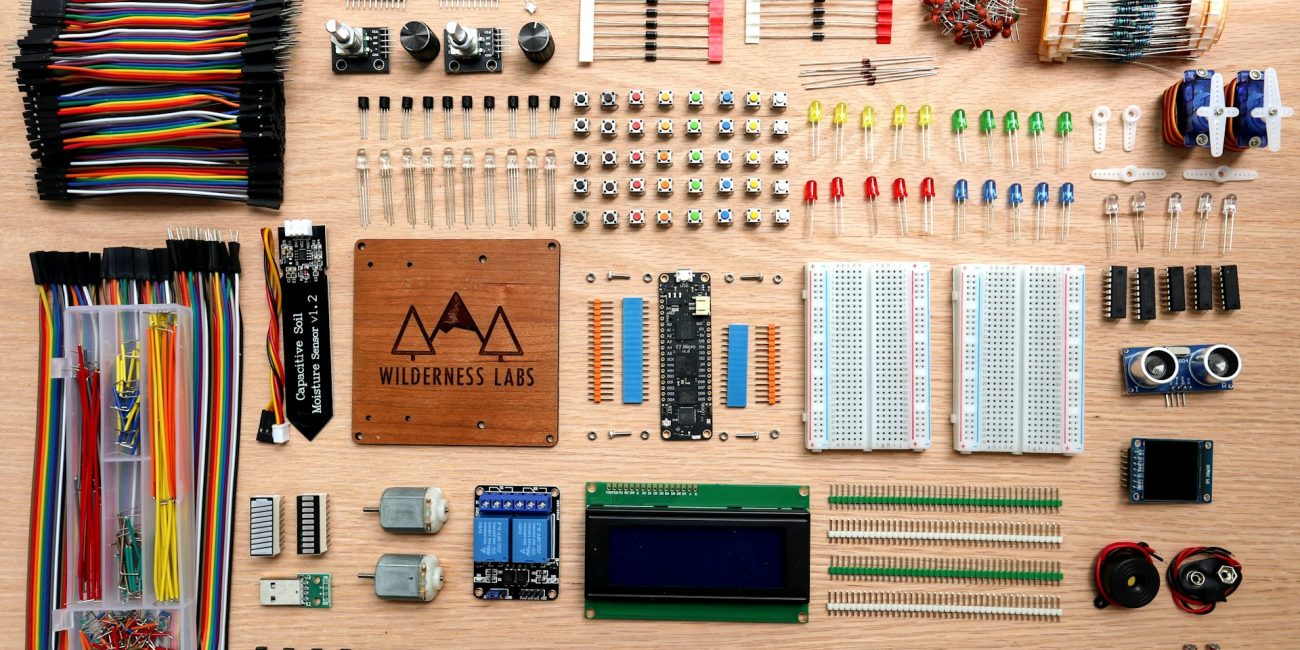
To get started with electronics, you don’t need a huge lab—just a core set of tools. Here’s a clear, practical list grouped by beginner, intermediate, and advanced levels so you can build your toolkit over time.
🔧 Beginner Essentials (Must-Have)
These are enough for hobby projects, learning circuits, and basic repairs.
- Multimeter
- For measuring voltage, current, and resistance.
- A digital multimeter (DMM) is recommended.
- Soldering Iron
- 25–60W temperature-controlled soldering iron.
- Solder wire (lead or lead-free) and soldering stand.
- Breadboard + Jumper Wires
- For building circuits without soldering.
- Wire Cutter / Stripper
- For cutting and stripping insulation from wires.
- Small Hand Tools
- Precision screwdriver set
- Needle-nose pliers
- Tweezers
- Power Supply (Basic)
- 9V/12V adapters or battery packs.
⚡ Intermediate Tools (Nice to Have)
If you’re doing more serious projects or repairs:
- Adjustable DC Bench Power Supply
- Lets you control voltage & current safely.
- Oscilloscope
- For viewing electrical signals; very helpful for debugging.
- Soldering Station + Accessories
- Flux, desoldering pump, and solder wick.
- Heat Shrink Tubing + Heat Gun
- For insulation and protecting connections.
- Digital Caliper
- For accurately measuring component sizes.
🧪 Advanced Tools (For Professionals or Serious Hobbyists)
- Function Generator
- Generates waveforms for testing circuits.
- Logic Analyzer
- For debugging digital circuits like microcontrollers.
- Hot Air Rework Station
- For SMD (surface-mount) soldering and desoldering.
- PCB Prototyping Tools
- UV exposure box (for etching)
- CNC engraver (optional)
🧰 Extra Helpful Items
- Storage boxes for resistors, ICs, etc.
- Anti-static mat / wrist strap
- Magnifier or microscope for tiny components
- Safety glasses
Next

December 10, 2025
What are the best games for seniors to play?
Previous
December 8, 2025
Is education still important with AI?





No Comment! Be the first one.